Technical & Engineering Deep-Dives · 2026-11-16
The Dominance Unleashed: A Deep Dive into Four-Wheel Drive in World Rally Cars
From the revolutionary Audi Quattro to today's sophisticated WRC machines, explore the technical journey of four-wheel drive systems that defined rally performance and engineering.
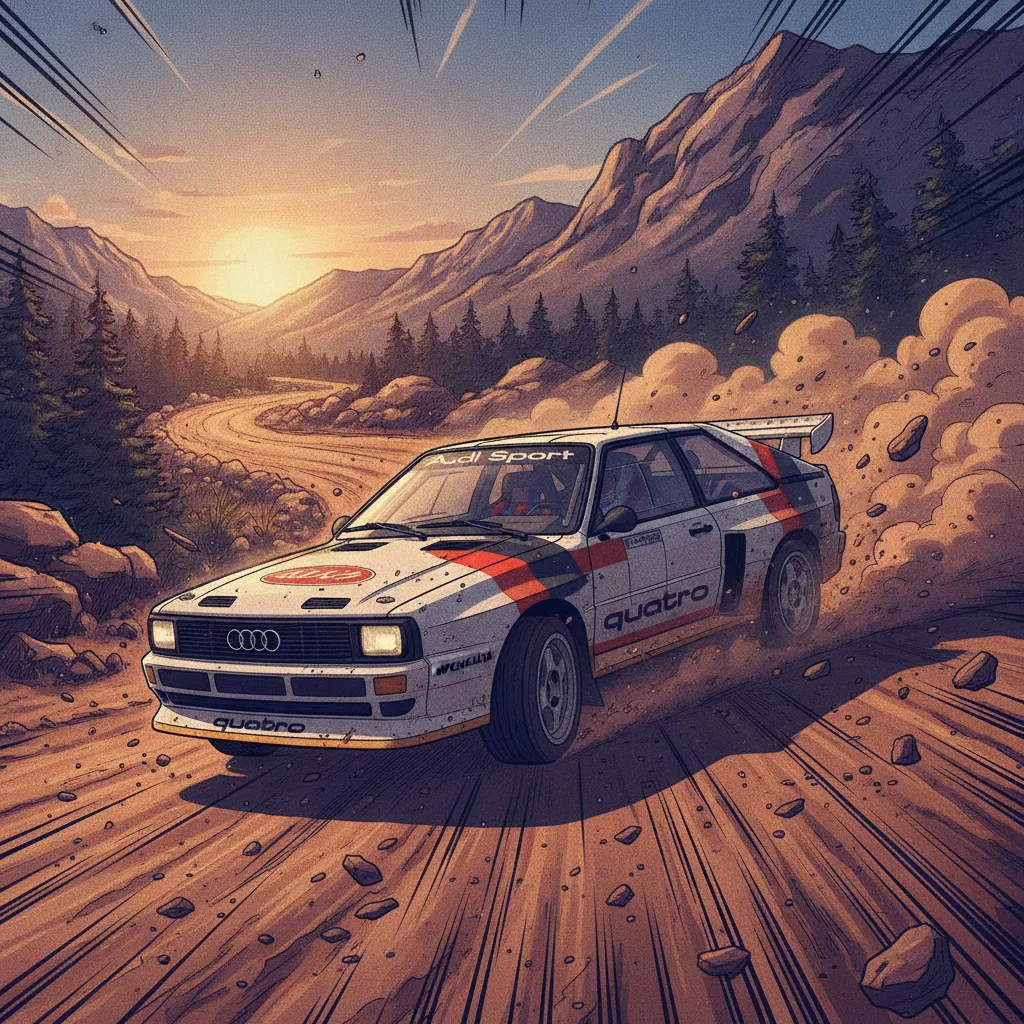
In the relentless theatre of international rallying, few technological advancements have proven as fundamentally transformative as the widespread adoption and continuous evolution of four-wheel drive (4WD) systems. This paradigm shift, from two-wheel drive to all-wheel traction, didn't merely offer an incremental advantage; it entirely redefined the parameters of grip, acceleration, and control across every conceivable loose-surface stage.
The Quattro Revolution: An Engineering Blueprint
The genesis of 4WD dominance is indelibly linked to the mighty Audi Quattro. Unveiled in 1980, its permanent 4WD system, initially employing a hollow secondary shaft within the gearbox to transmit power, was nothing short of revolutionary. Suddenly, the immense power outputs of turbocharged engines could be effectively deployed, overcoming the previous limitations of wheelspin on gravel, snow, and mud. This era saw engineers grappling with differential choices – open, locking, and eventually the Torsen mechanical limited-slip differentials – to optimize torque distribution and maximize traction, allowing drivers to exploit higher corner entry speeds and unleash power earlier out of the apex.
Group B & Group A: The Pursuit of Traction
The ballistic power output of Group B monsters pushed 4WD technology to its absolute limits. Manufacturers like Peugeot and Lancia experimented with vastly different longitudinal and transverse engine layouts, each influencing the central differential's placement and the overall weight distribution. With Group A regulations, the focus shifted towards homologation models, bringing more advanced mechanical and hydromechanical centre differentials into the fold. The arrival of electronically controlled active differentials in the 1990s, pioneered by cars like the Toyota Celica GT-Four and Subaru Impreza WRC, offered unprecedented programmability, allowing engineers to dynamically adjust torque split front-to-rear based on steering angle, throttle position, and wheel speed. This precision enabled drivers to fine-tune the car's handling characteristics, from understeer to oversteer, with remarkable on-the-fly adaptability.
Modern WRC: Refinement and Controlled Performance
Today's Rally1 machines, while constrained by stricter regulations on active differentials and centre differential designs, still rely on incredibly sophisticated 4WD systems. A mechanical front and rear differential, combined with a passive centre differential, ensures robust and predictable torque distribution. While lacking the full electronic adjustability of their predecessors, these modern units are engineered for maximum reliability and efficiency, designed to handle the immense transient loads of high-speed jumps and complex terrain. The constant pursuit of mechanical grip, combined with optimized suspension geometry and aero packages, means that every ounce of traction delivered through the 4WD system is meticulously managed, ensuring that the driver remains the ultimate arbiter of performance.
Ready to sell? List your rally car or parts for free.
Post an ad