Legendary Cars & Engineering · 2026-11-07
The Grip Advantage: How Four-Wheel Drive Conquered World Rally
Explore the technical revolution of four-wheel drive in rally, tracing its impact from the Audi Quattro's dominance to the sophisticated systems in modern WRC cars.
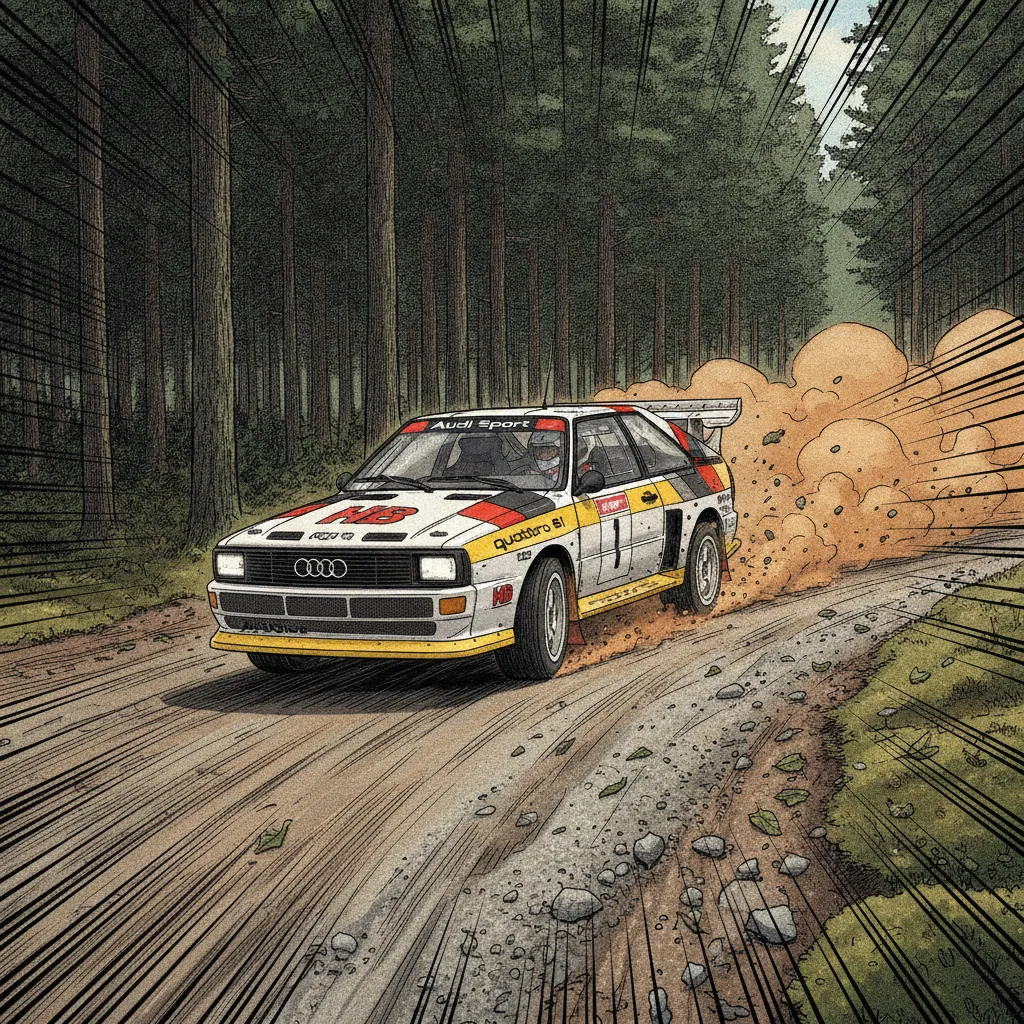
Before the dawn of the 1980s, the world of international rallying was predominantly a rear-wheel drive (RWD) affair. Powerful, often tail-happy machines danced across gravel and tarmac, demanding immense skill and precision from their pilots. Then, a paradigm shift occurred, spearheaded by a single, revolutionary machine: the Audi Quattro. This vehicle didn't just compete; it fundamentally rewrote the technical rulebook, demonstrating an unyielding grip advantage that would permanently alter the trajectory of motorsport engineering.
The Quattro Revolution: A Technical Masterclass
Audi's introduction of permanent four-wheel drive (4WD) to the World Rally Championship in 1981 was initially met with skepticism. Critics questioned the added weight and complexity. However, the Quattro's inherent ability to deploy power across all four wheels, especially out of corners and on loose surfaces, quickly silenced doubters. Its centre differential, initially a manual lockable unit, provided unparalleled traction and stability. This mechanical advantage meant faster acceleration, superior braking stability, and ultimately, significantly quicker stage times. The sheer grip allowed drivers to attack corners with an aggression previously unimaginable in RWD machinery, revolutionising driving styles and vehicle setups.
The Group B era, a crucible of motorsport innovation, saw other manufacturers rapidly follow Audi's lead, evolving their own 4WD systems. This period was crucial for the development of more sophisticated differentials, including viscous couplings and later, electronically controlled active differentials. The intense competition drove exponential advancements in power distribution strategies, allowing for dynamic torque split adjustments between axles to optimise longitudinal and lateral grip across a myriad of surfaces – from frozen Swedish snow to dusty African plains.
Modern Dominance: From Mechanical to Electronic Sophistication
Today, four-wheel drive is the absolute bedrock of modern WRC performance. The systems found in contemporary rally cars are engineering marvels, far removed from the mechanical simplicity of the early Quattro. Hydraulic and electronic differentials, meticulously managed by advanced control units, provide precise torque vectoring capabilities. Engineers can program highly specific power delivery maps for different stages and grip conditions, ensuring every ounce of engine torque is translated into forward momentum with minimal slip. This seamless interaction between engine, drivetrain, and chassis ensures supreme control and unmatched efficiency, allowing drivers to exploit the very limits of adhesion.
From a radical concept once dismissed as overly complex, 4WD has cemented its status as an indispensable component of elite rallying. It represents the ultimate pursuit of traction, stability, and speed, embodying the relentless technical evolution that defines motorsport at its pinnacle. The grip advantage proven by the original Quattro continues to define the sport, ensuring exhilarating, precise, and utterly dominant performances.
Ready to sell? List your rally car or parts for free.
Post an ad