Legendary Cars & Engineering · 2026-10-31
The Quantum Leap: How Four-Wheel Drive Forged Modern Rallying
The introduction of four-wheel drive transformed rally motorsport, fundamentally altering vehicle dynamics and elevating performance thresholds across every surface.
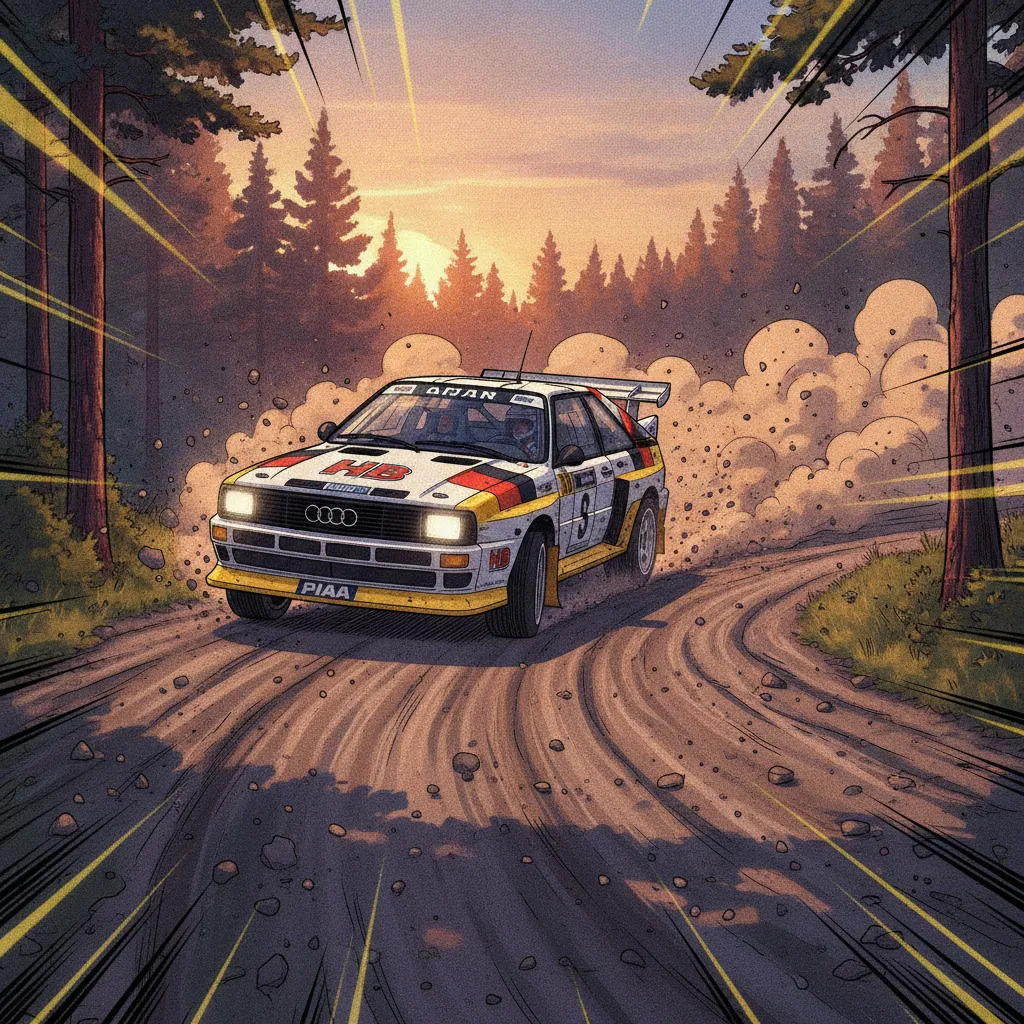
The annals of motorsport are replete with game-changing innovations, but few have delivered as profound a paradigm shift as the advent of four-wheel drive (4WD) in international rallying. Before its widespread adoption, two-wheel drive (2WD) machines, predominantly rear-wheel drive, wrestled for traction on the treacherous, varied surfaces of the rally stages. The arrival of 4WD didn't just offer an advantage; it represented a fundamental re-engineering of the rally car, demanding new driving techniques and setting unprecedented benchmarks for speed and control.
The Audi Quattro Revolution
It was in the early 1980s that the motorsport world witnessed the full, terrifying potential of 4WD with the debut of the Audi Quattro. Its groundbreaking application of all-wheel traction on loose gravel, snow, and even wet tarmac stages was nothing short of revolutionary. Suddenly, the power previously limited by grip on just two wheels could be effectively deployed through all four, resulting in blistering acceleration out of corners and unparalleled stability through high-speed sections. The Quattro’s longitudinal engine placement and robust center differential allowed for effective torque distribution, ensuring every horsepower found its way to the ground, pulling the car with relentless determination.
This initial foray rapidly cascaded through the sport. Group B homologation specials like the Peugeot 205 T16 and Lancia Delta S4 refined the concept, often incorporating advanced differential technologies and sophisticated power distribution systems that could dynamically shift torque between axles. The sheer mechanical grip afforded by 4WD allowed engineers to unleash colossal power figures, culminating in an era of unprecedented speed and danger.
The Enduring Legacy of All-Wheel Traction
Even after the dramatic curtailment of Group B, 4WD remained the undisputed standard. From Group A to the modern World Rally Cars (WRC), manufacturers like Lancia, Subaru, Mitsubishi, Ford, and Toyota continued to innovate, developing sophisticated active differentials, electronically controlled torque vectoring, and optimized suspension kinematics designed to exploit the inherent advantages of all-wheel traction. These systems allowed for nuanced control over the car's attitude, enabling drivers to 'steer' with the throttle and exploit every millimeter of grip available.
Today, 4WD is not merely a feature; it is the foundational pillar upon which modern rally car engineering is built. It underpins the entire dynamic envelope of these incredibly complex machines, allowing them to conquer the world’s most challenging terrains with a balletic blend of brute force and surgical precision. The evolution of 4WD is, in essence, the evolution of rallying itself, a testament to relentless innovation in pursuit of ultimate performance.
Ready to sell? List your rally car or parts for free.
Post an ad