Rally Eras & Class Evolution · 2026-11-17
From Game Changer to Gold Standard: The Enduring Legacy of 4WD in Rallying
Explore the seismic shift that four-wheel drive technology brought to rally motorsport, from its revolutionary introduction with the Audi Quattro to its current sophisticated WRC applications, detailing the engineering prowess behind ultimate traction.
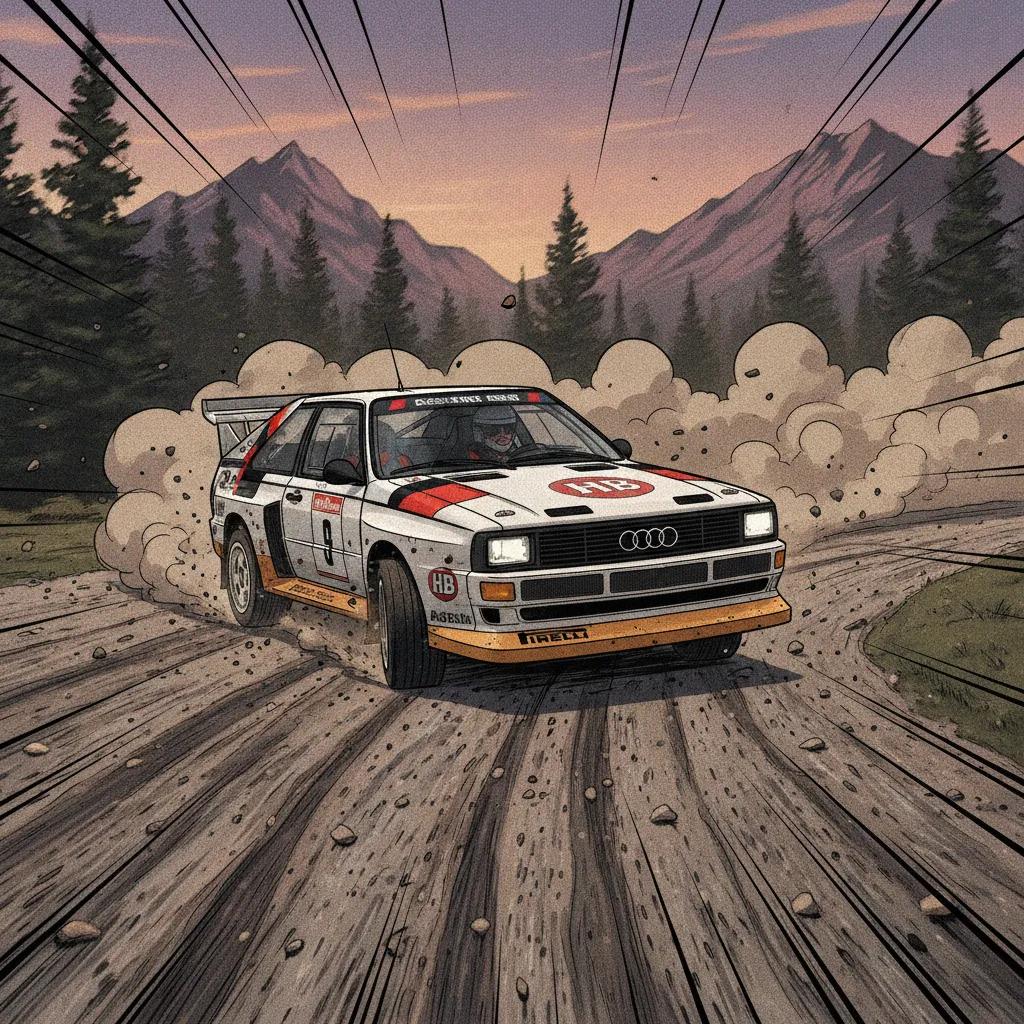
The landscape of international rallying underwent a seismic shift in the early 1980s, fundamentally redefined by the advent of four-wheel drive (4WD) technology. Prior to this, the rear-wheel drive (RWD) platforms, while powerful, struggled to effectively transmit their prodigious torque to the loose surfaces of rally stages. The introduction of 4WD wasn't merely an incremental upgrade; it was a paradigm shift that rewrote the rulebook on grip, traction, and stage dominance.
The Quattro Revolution and Group B Ascendancy
At the vanguard of this revolution was the Audi Quattro, a machine initially met with skepticism by an establishment deeply entrenched in RWD tradition. Yet, its symmetrical all-wheel-drive system, featuring a groundbreaking Torsen centre differential, proved devastatingly effective. The ability to distribute torque dynamically to all four wheels, even on low-grip gravel or snow, offered an unparalleled advantage in acceleration and corner exit speed. This technical superiority was rapidly evident, forcing competitors to scramble for their own 4WD homologation specials. The subsequent Group B era became an arms race of 4WD innovation, with manufacturers like Peugeot and Lancia pushing the boundaries of active differentials, complex torque splits, and advanced kinematic chains to extract every ounce of performance from their monstrous machines.
Post-Group B, the World Rally Championship continued to refine 4WD systems. While the outright power was curtailed, the engineering focus shifted to sophisticated electronic control, further enhancing the adaptability and precision of torque distribution. Longitudinal engine layouts, often preferred in early 4WD designs for optimal weight distribution and simpler drivetrain geometry, competed with transverse configurations that allowed for more compact packaging and better front-rear weight balance on the chassis. The constant battle was to perfect the interaction between mechanical grip and electronic management, ensuring maximum drive on every surface.
Modern WRC: A Testament to 4WD's Enduring Principle
Today's hybrid WRC machinery stands as a testament to the enduring principle of 4WD. While the technologies are far more advanced – integrating complex hybrid powertrains, highly sophisticated active differentials, and intricate suspension geometry – the core mission remains unchanged: deliver power to the ground with unyielding efficiency. The precision with which a modern rally car can modulate torque across all four wheels, adapting instantaneously to varying grip levels, is a direct legacy of those early 4WD pioneers. Four-wheel drive didn't just transform rallying; it became its indispensable foundation, solidifying its status as the unequivocal gold standard for competitive off-road motorsport.
Ready to sell? List your rally car or parts for free.
Post an ad