Rally Eras & Class Evolution · 2026-10-15
The Unshakeable Grip: Charting Four-Wheel Drive's Rallying Revolution
Explore the transformative journey of four-wheel drive in rally, from the revolutionary Audi Quattro to the sophisticated hybrid systems defining modern WRC, showcasing relentless engineering innovation.
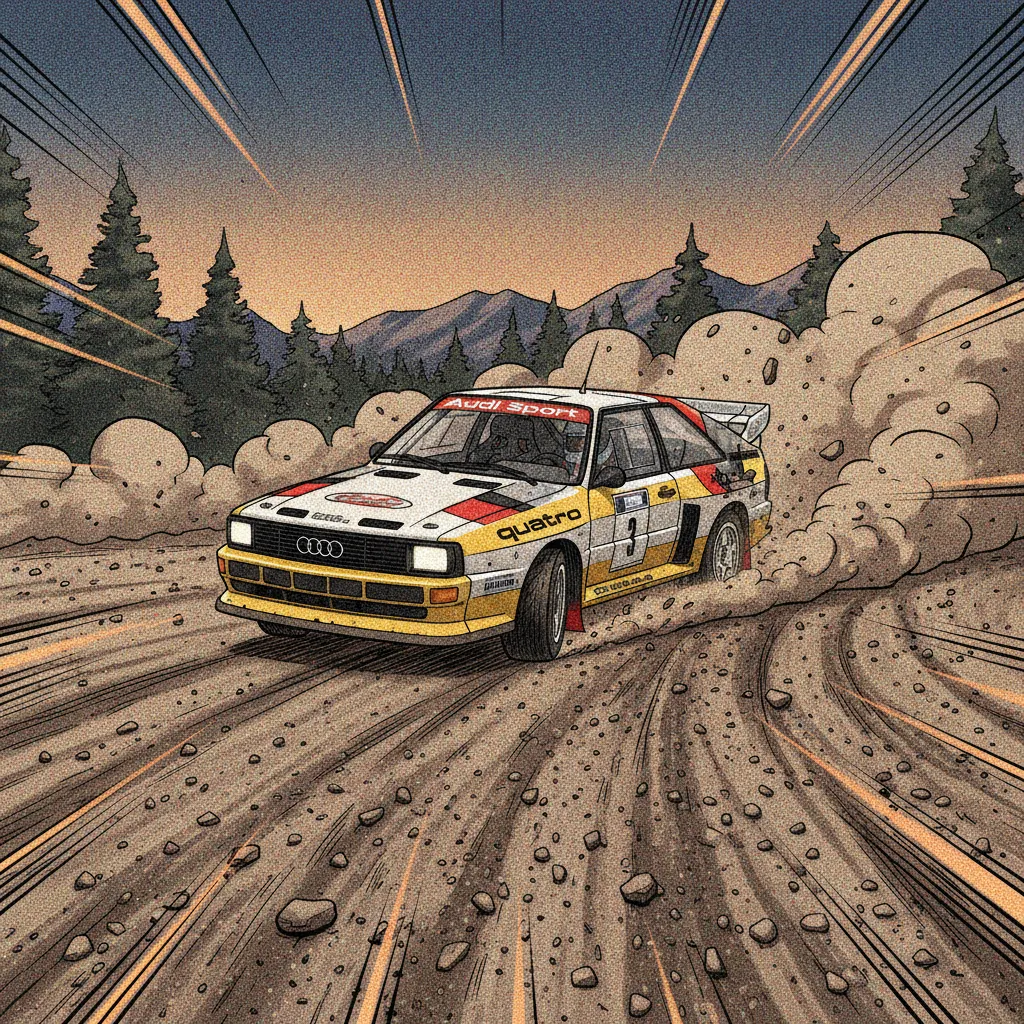
The landscape of international rallying irrevocably shifted the moment Audi unveiled its Quattro in 1980. Before this pioneering machine, two-wheel drive was the established norm, reliant on mechanical grip and driver finesse. The Quattro, with its revolutionary permanent four-wheel drive system, offered an unprecedented level of traction and stability, fundamentally redefining what was possible on loose surfaces. Its longitudinal engine and ingenious centre differential allowed for efficient torque distribution to all four wheels, propelling it to immediate, dominant success and forever stamping its mark as the catalyst for rallying's 4WD era.
From Group B Beasts to WRC Complexity
The Group B regulations of the mid-1980s saw other manufacturers scramble to emulate Audi's success, developing monstrously powerful 4WD machines like the Peugeot 205 T16 and Lancia Delta S4. These turbocharged beasts, though short-lived, pushed the boundaries of power delivery and chassis dynamics, proving the inherent superiority of four-wheel traction when wrestling hundreds of horsepower across brutal stages. The subsequent Group A era, whilst reining in power, continued the 4WD mandate, ushering in iconic homologation specials like the Lancia Delta Integrale, Toyota Celica GT-Four, and Subaru Impreza. Here, the focus shifted from raw power to sophisticated drivetrain management, with the introduction of increasingly advanced mechanical and viscous centre differentials optimizing torque split and handling balance.
Today's FIA World Rally Championship (WRC) Rally1 cars represent the pinnacle of 4WD evolution. Gone are purely mechanical systems, replaced by complex active differentials, electronically controlled to precisely manage torque distribution across both axles. These sophisticated setups work in conjunction with advanced suspension geometry and aerodynamic packages to provide unparalleled grip and responsiveness. The current hybrid era further layers complexity, integrating a 100kW Motor Generator Unit (MGU) alongside the 1.6-litre turbocharged internal combustion engine. This hybrid system not only provides bursts of additional power but also recovers kinetic energy, influencing weight distribution and further refining power delivery through its integration with the 4WD system, creating a dynamic, adaptable traction envelope never before seen.
From the raw, mechanical advantage of the original Audi Quattro to the finely tuned, electronically orchestrated hybrid systems of today's WRC contenders, four-wheel drive has remained the indispensable foundation of top-tier rallying. It is a testament to relentless engineering innovation, continuously pushing the limits of grip, control, and outright speed on the world’s most challenging terrains.
Ready to sell? List your rally car or parts for free.
Post an ad