Legendary Cars & Engineering · 2026-11-27
The Quantum Leap: How Four-Wheel Drive Revolutionized Rallying
The advent of four-wheel drive (4WD) stands as arguably the single most pivotal technical innovation in rallying, fundamentally redefining performance and car design. From the pioneering Audi Quattro to today's active differential systems, 4WD transformed the sport.
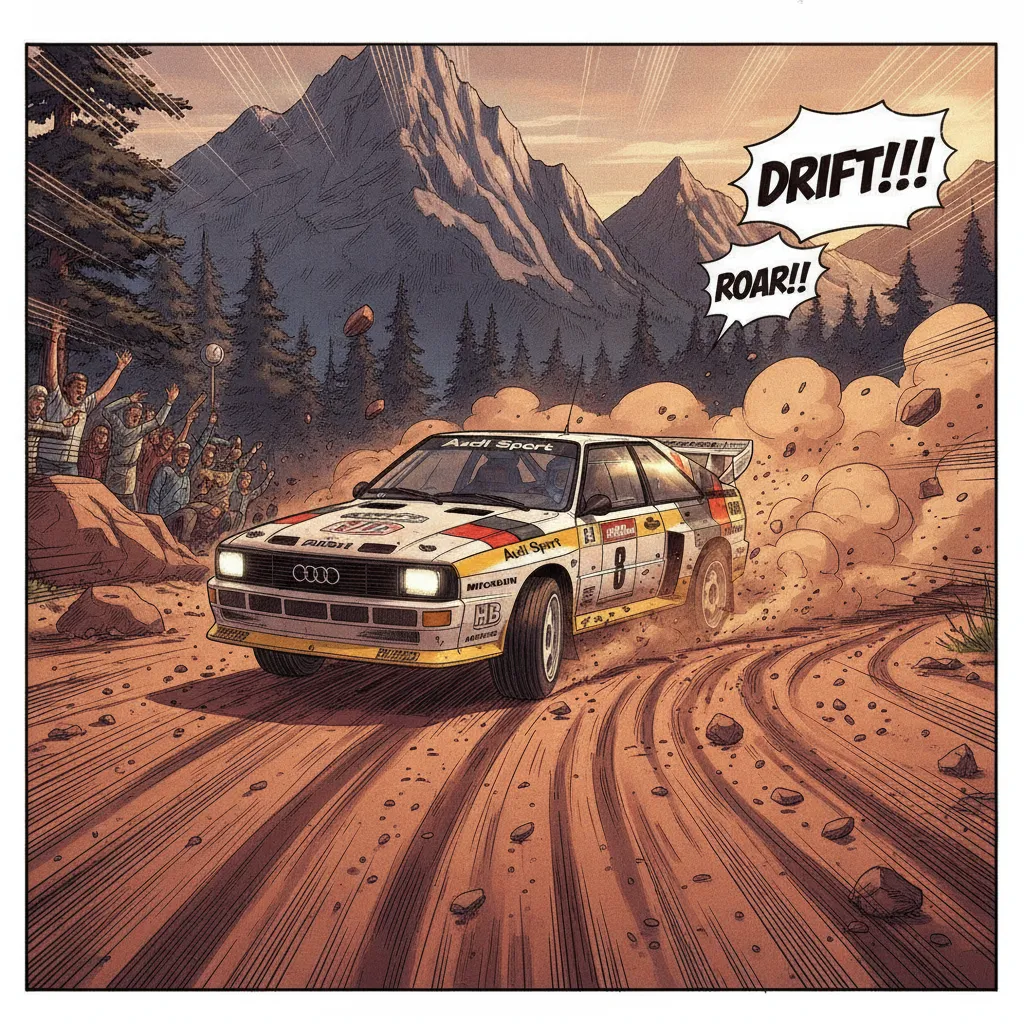
The advent of four-wheel drive (4WD) stands as arguably the single most pivotal technical innovation in the history of international rallying. Prior to its widespread adoption, two-wheel drive (2WD) machines, typically rear-wheel drive (RWD), were the norm. While powerful and often spectacular, their inherent traction limitations, particularly on low-grip surfaces like gravel, snow, and ice, restricted corner exit speeds and acceleration. The paradigm shift initiated by 4WD not only redefined performance benchmarks but also profoundly altered car design, driving techniques, and the very spectacle of the sport.
The Quattro Catalyst and Group B Zenith
The undisputed game-changer arrived in 1980 with the Audi Quattro. Initially met with skepticism, its permanent 4WD system, featuring a revolutionary hollow shaft for the centre differential, delivered unprecedented grip and traction. Competitors soon discovered that even with a heavier drivetrain, the ability to put power down effectively translated into significantly faster stage times. The Quattro's dominance forced every major manufacturer to re-evaluate their rally programmes. This innovation reached its brutal zenith in the Group B era, where machines like the Peugeot 205 T16 and Lancia Delta S4 pushed the envelope of 4WD technology. These bespoke homologation specials employed advanced central differentials, some with viscous couplings or even active hydraulic systems, to intelligently distribute monstrous torque from turbocharged engines across all four wheels, navigating treacherous stages with mind-boggling agility.
WRC Refinement and Modern Mastery
As rallying transitioned into the Group A and subsequently the World Rally Car (WRC) era, the 4WD blueprint was refined. Iconic cars like the Subaru Impreza WRC and Mitsubishi Lancer Evolution became synonymous with rally success, leveraging sophisticated active centre, front, and rear differentials. These electronically controlled systems could instantaneously adjust torque split based on sensor data – steering angle, throttle position, wheel speed – optimizing grip and handling dynamics for every millisecond of a special stage. Modern WRC machinery continues this lineage, featuring highly complex sequential transmissions mated to advanced active differentials, further enhancing traction, stability, and responsiveness. The continuous evolution of 4WD technology, from the mechanical simplicity of early systems to today's electronic marvels, underscores its foundational role in crafting the blistering pace and spectacular nature of contemporary rally motorsport.
See what is on the market right now: all the rally cars for sale on RallyCarsMarket.
Searching to buy:
See all listings
Want to sell yours? Listing a rally car or parts is free.
Post your Ad