Rally Personalities & Legends · 2026-11-21
The Unyielding Grip: A Technical Journey Through Rallying's Four-Wheel Drive Evolution
Explore the pivotal role and technical progression of four-wheel drive systems, from the revolutionary Audi Quattro to today's electronically sophisticated WRC machines, defining rally car performance.
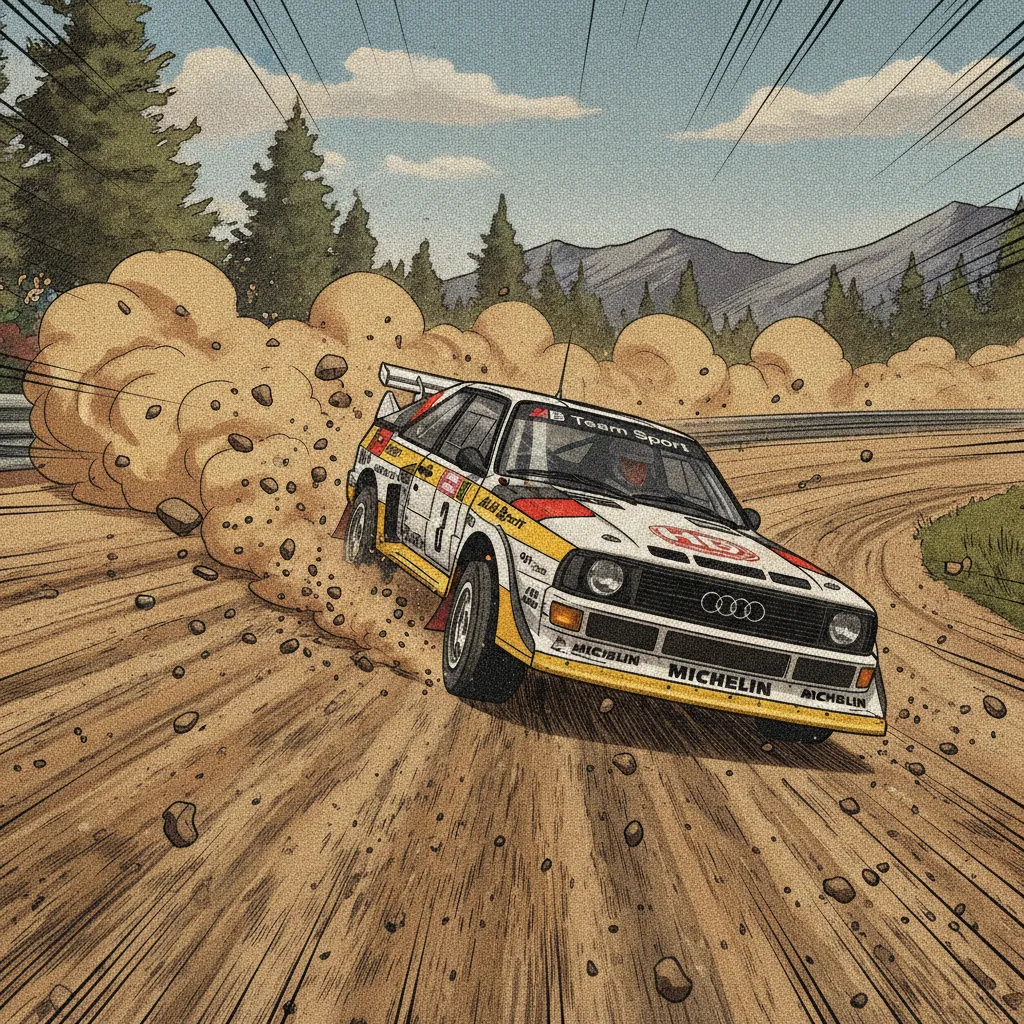
In the high-stakes world of international rallying, where success hinges on exploiting every ounce of available traction across wildly diverse terrains, the four-wheel drive (4WD) system stands as arguably the most critical engineering differentiator. Far more than a simple advantage, 4WD transformed rallying from a contest of driver skill and brute power into a highly technical chess match between grip, torque distribution, and dynamic control.
The Quattro Catalyst and Beyond
The paradigm shift began in 1980 with the Audi Quattro. Before its arrival, front and rear-wheel drive cars dominated, but Audi's bold move to bring its permanent 4WD system to the World Rally Championship instantly rendered the old guard obsolete. The Quattro's revolutionary longitudinal engine and innovative centre differential allowed for unprecedented torque distribution, providing mechanical grip that left competitors scrambling. Its immediate dominance highlighted the undeniable performance benefits of effectively channeling power to all four wheels, especially on loose surfaces like gravel, snow, and mud.
The ensuing Group B era saw an explosion of 4WD innovation. Manufacturers experimented with advanced mechanical systems featuring viscous couplings, Torsen differentials, and complex planetary gears, all aiming to optimize torque split and enhance traction under extreme conditions. Even as Group B gave way to the more regulated Group A, the technical arms race continued, focusing on refining these mechanical marvels and introducing early electronic interventions to further fine-tune power delivery.
Modern WRC: Electronic Sophistication
Today's World Rally Championship machines represent the zenith of 4WD engineering. They employ highly sophisticated active centre, front, and rear differentials, all managed by ultra-fast Electronic Control Units (ECUs). These systems continuously monitor a myriad of parameters – steering angle, throttle position, brake pressure, wheel speed, and G-forces – to dynamically adjust hydraulic pressure within the differentials, meticulously controlling the torque split to each wheel in milliseconds. This allows for unparalleled slip management and traction vectoring, enabling drivers to precisely exploit every fractional bit of available grip, carving lines that were once unthinkable.
The evolution of 4WD in rallying is a testament to relentless engineering pursuit. From the foundational mechanical genius of the Audi Quattro to the hyper-intelligent electronic brains of modern WRC cars, the quest for the ultimate grip and dynamic stability continues to drive innovation, defining the very essence of top-tier rally car performance.
Ready to sell? List your rally car or parts for free.
Post an ad