Rally Personalities & Legends · 2026-11-18
The Unbridled Engineering of Group B: A Homologation Legacy
Group B wasn't just a category; it was an engineering arms race, pushing automotive design to its limits under the guise of homologation, forging rally legends.
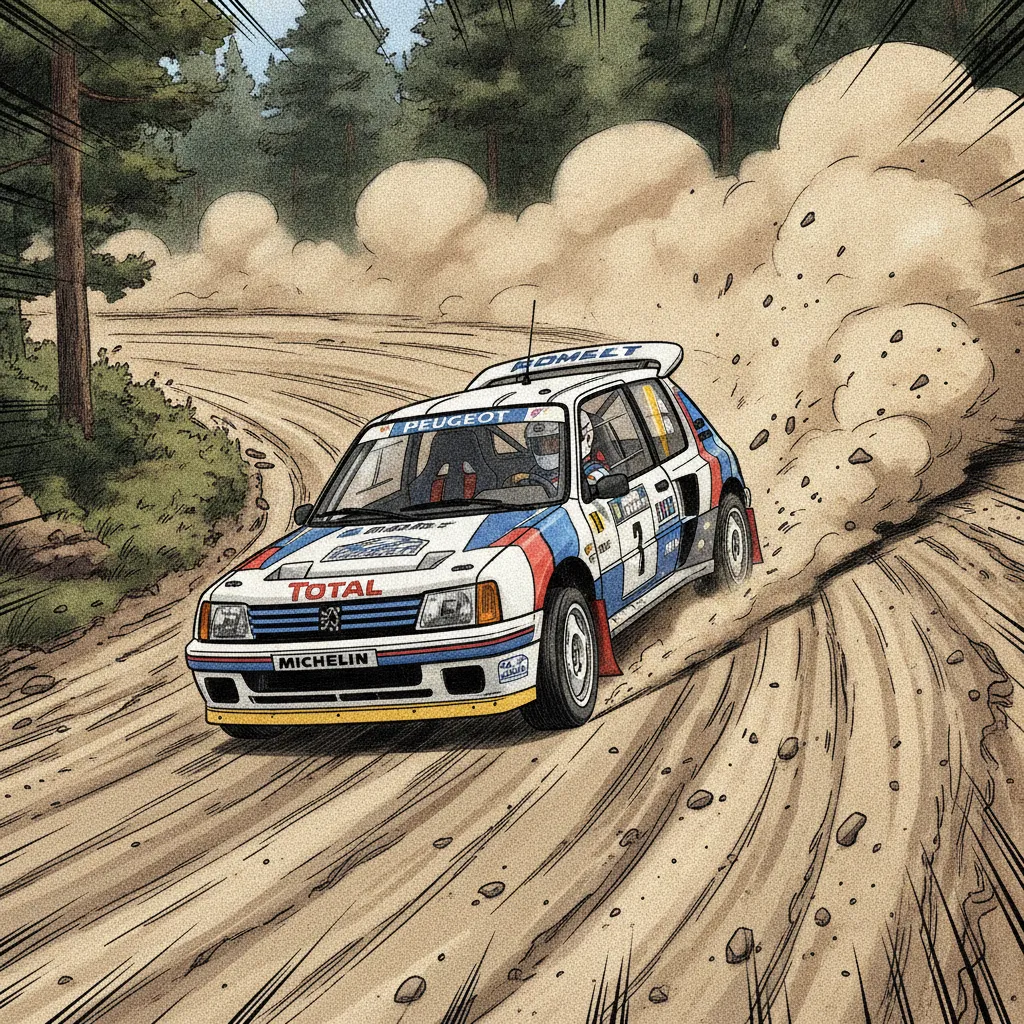
The Group B era, often romanticized and rightly so, stands as an unparalleled chapter in motorsport history, driven by an engineering philosophy that defied convention. From 1982 to 1986, the Fédération Internationale de l'Automobile (FIA) regulations, requiring only 200 road-going units for homologation, unleashed an unholy alliance of ingenuity and audacious design. This wasn't merely about building fast cars; it was an intense, no-holds-barred engineering battle where every advantage, no matter how marginal, was relentlessly pursued.
Homologation as the Catalyst for Innovation
The 200-unit rule provided manufacturers with a tantalizing loophole: build a barely road-legal prototype, then develop "evolution" models with minimal additional homologation. This freedom gave rise to bespoke spaceframe chassis, abandoning production platforms entirely. Engineers embraced exotic materials like Kevlar and carbon fiber, drastically reducing mass to achieve previously unfathomable power-to-weight ratios. Forced induction became standard, with turbocharged engines routinely exceeding 500 bhp, sometimes touching 600 bhp, delivered through sophisticated all-wheel-drive (AWD) systems or, in the case of the venerable Lancia 037, a defiant rear-wheel-drive configuration.
The shift to mid-engine layouts became a predominant strategy for optimal weight distribution and handling balance, exemplified by machines like the Peugeot 205 T16 and the Ford RS200. Complex suspension geometry, variable differential locking, and increasingly advanced aerodynamics, featuring prominent wings and ground-effect skirts, were not just add-ons but integral components of their performance envelope. Every component, from the intercooler setup to the sequential gearbox, was meticulously engineered to withstand the brutal demands of rally stages, pushing the boundaries of material science and mechanical endurance.
The Legacy of an Engineering Arms Race
The engineering arms race among manufacturers fostered an environment of rapid, groundbreaking development. Audi's pioneering Quattro concept, with its revolutionary AWD system, initially redefined traction. Lancia countered with the lightweight, supercharged, and turbocharged S4, blending RWD agility with power. Peugeot's mid-engined, AWD T16 proved a formidable challenger, showcasing incredible balance and adaptability. While the spectacular speeds and inherent dangers ultimately led to Group B's tragic demise, its technological legacy is undeniable. The extreme experimentation with turbocharging, AWD, composite materials, and advanced chassis design laid crucial groundwork that continues to influence modern rally machines and high-performance road cars alike. Group B remains a testament to what is possible when engineering ambition is given near-absolute creative license.
Ready to sell? List your rally car or parts for free.
Post an ad